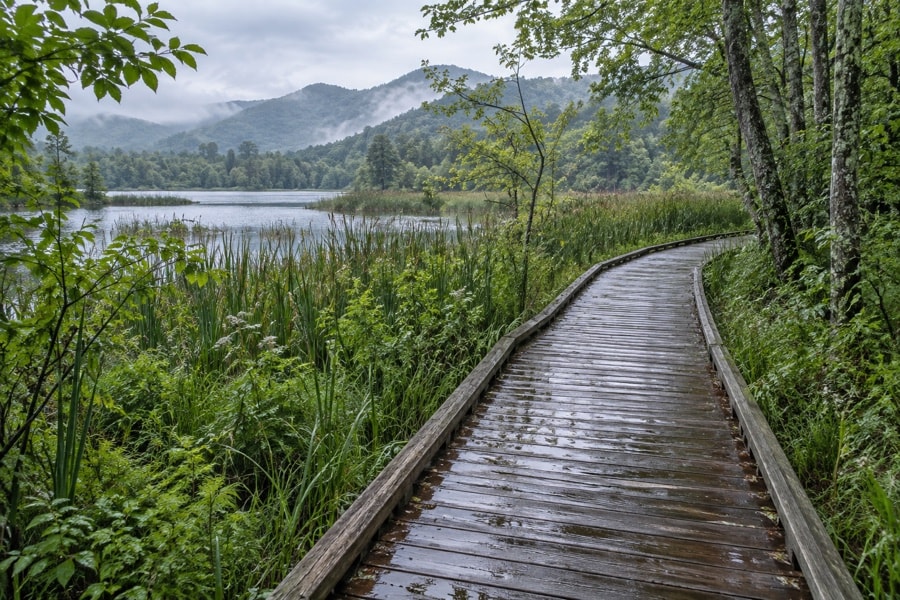
Beaver Lake Bird Sanctuary sits in north Asheville as a compact meeting of open water, marsh vegetation, damp ground and woodland edge. Its scale encourages close observation. Rather than treating the loop as a route to finish, move through it as a sequence of listening stations.
Several habitats in a short circuit
The boardwalk brings visitors beside vegetation that would otherwise be difficult to approach without damaging wet soil. Open-water views ask for a wide scan. Reed and shrub edges reward a tighter search for movement. Trees along the drier boundary create a vertical field from low branches to canopy. Each shift changes the best viewing method.
Begin by standing still. Reflections and backlighting can hide movement, so change the angle before changing the location. Scan with the unaided eye, then use binoculars to examine a promising patch. Listen across the water as well as into the woods; sound can reveal activity concealed by leaves.
The sanctuary’s boardwalk forms a loop, but the experience need not be linear. Revisit an overlook from the opposite direction. A location that seems empty on the first pass may become active once conversation and footfall have moved on.
Quiet is part of the habitat
Good wetland etiquette protects both wildlife and other visitors. Stay on the established route, keep voices low, carry out every item brought in, and never feed wild animals. Give anyone who is watching or listening room to work without interruption. If a bird changes behavior because of your position, add distance.
Recorded calls can alter a bird’s behavior and can affect the experience of people nearby. A restrained approach is best: observe natural sound rather than trying to produce a response. Photography should follow the same rule. No image is worth pushing through vegetation or holding a bird’s attention.
Prepare for a living place
Conditions at a wetland change after rain, wind and maintenance work. Wear footwear that can handle damp surfaces and bring only what can be carried comfortably. A small notebook is often more useful than extra equipment: write down habitat, light and behavior while the details are fresh.
Do not rely on old directions, fixed hours or an inherited checklist. Confirm conditions with the responsible land manager before traveling. The purpose of this page is durable field orientation, not a substitute for current access information.
Continue around the lake
The companion guide, birds of Beaver Lake through the year, treats the sanctuary as a changing seasonal landscape rather than repeating this visitor overview. To compare the wetland with open game land and high-elevation forest, continue to local birding places in western North Carolina.