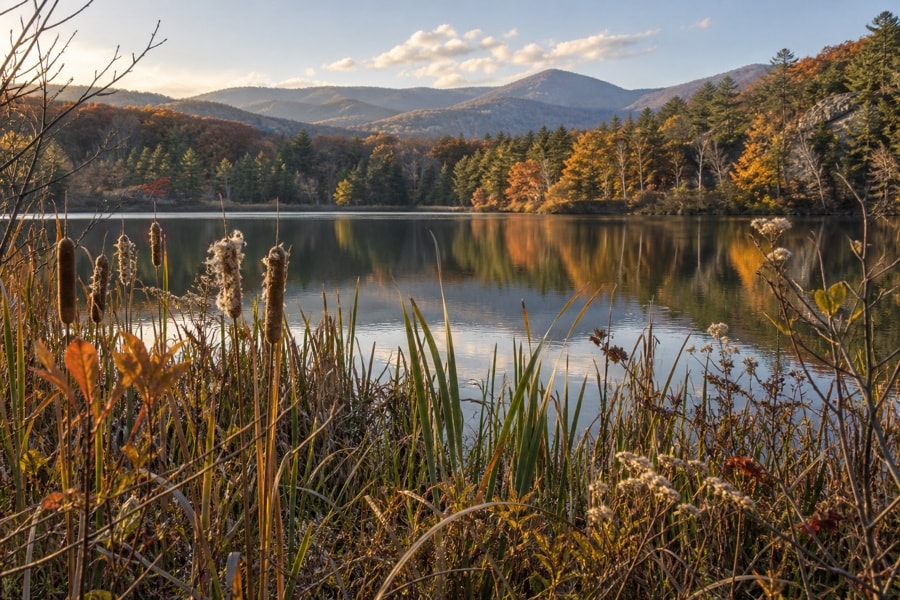
A seasonal guide should help a birder ask better questions, not promise a list. At Beaver Lake, the useful question is less “What will be here?” than “Which part of the habitat is most readable today?” The answer changes across the year and sometimes across a single morning.
Winter: structure comes forward
With fewer leaves on deciduous branches, sightlines through the woodland edge can lengthen. Trunks, vine tangles and seed heads become easier to separate. Scan the water before entering the boardwalk and look again from each opening; differences in glare and wind can make the same surface feel new.
Winter rewards deliberate coverage. Watch sheltered water, exposed perches and the leaf litter as distinct zones. Listen for short notes that might otherwise be masked by summer insects. Cold hands and stiff equipment can shorten attention, so keep the kit simple and use layers that allow quiet movement.
Spring: listen before searching
Spring migration brings more sound and motion through western North Carolina. At a leafy edge, the first clue is often a call from a layer of vegetation rather than a clear view. Stop before raising binoculars. Decide whether the sound is high or low, near water or in the canopy, repeated or passing.
Fresh leaf growth can close a view quickly. Work small openings instead of sweeping the entire canopy. A moving branch, a brief silhouette and a remembered call pattern can be recorded without forcing an identification. The National Park Service’s Parkway bird overview provides regional context for spring and fall movement across elevations.
Summer: read behavior, not just color
Dense foliage makes patient observation important. Watch repeated routes between cover and open branches, and avoid approaching any bird that appears focused on a particular patch of vegetation. Repeated alarm notes or agitation are reasons to back away.
Summer visits can also be visually busy. Reflections, moving leaves and strong patches of sun make colors unreliable. Note shape, movement and habitat before plumage. If a bird remains partly hidden, a broad identification may be the most accurate conclusion.
Fall: expect mixtures and uncertainty
Fall movement can bring quick changes in activity. Quiet periods may be followed by several birds moving together through an edge. Many are less conspicuous than in spring, and the angle of light across the lake can complicate the view. Slow down, track one bird at a time and write notes before consulting a guide.
For records intended for eBird, include where and when you watched, the observation method and the birds you could support. The eBird checklist guide explains those core fields and why complete reporting matters.
The value of returning
A repeated route builds familiarity with normal water levels, common sounds and the shape of each viewing gap. That familiarity makes change easier to notice. Keep field notes comparable: use the same general route, record start and finish time, and describe weather without turning memory into precision it did not have.
Repeat visits also make restraint easier. Once every stop is not treated as a one-time chance, there is less reason to approach a bird, remain at a crowded viewing point or force a sight line through vegetation. Note where the best natural openings occur and let distance be part of the observation. A short, quiet record can be more revealing than a long pursuit.